Details
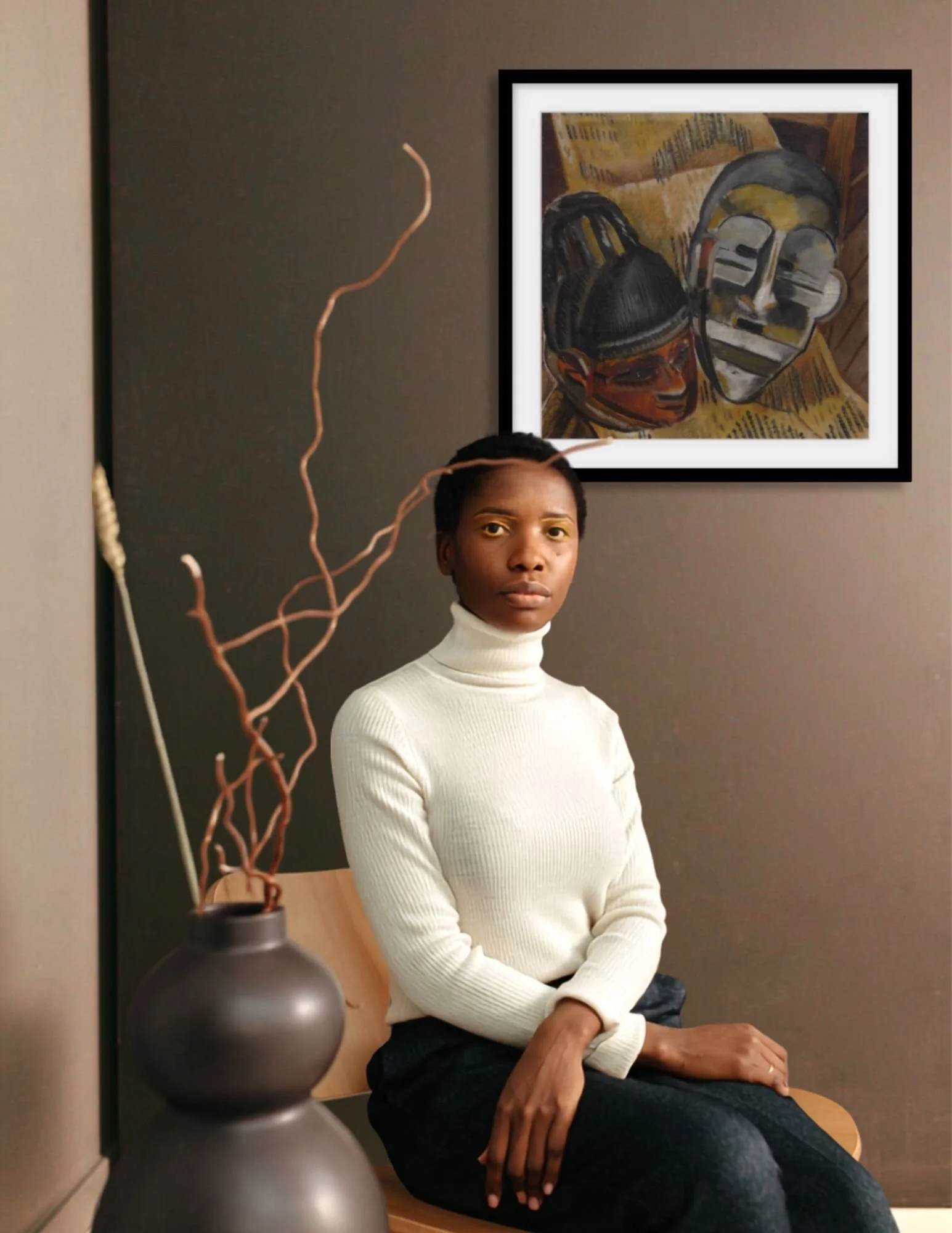
This 1932 work by Harlem Renaissance artist Malvin Gray Johnson depicts two West African masks — one Yoruba, the other Bwa. The work is a response to several occurrences in the art scene at that time. First, was a challenge issued by Johnson's friend and mentor, Alain Locke, author of the 1925 New Negro Anthology, to several Black artists to find inspiration in African art. Second, it was a rebuff to the presentation of African art, which was growing in popularity at the time along with European modernist art, as the work of "savages," despite being a significant inspiration for Modernism itself. Negro Masks is one of sixty surviving works by the artist, who tragically passed away at the age of 38 in 1934. Celebrated in his time for his portraits, Malvin is remembered as a pioneering example of Symbolic Abstractionism and Cubist painting. Printed on 5.57 oz smooth matte fine art paper, this work is available framed and unframed, reproduced by archivists in the United Kingdom using museum quality paper and ink, resulting in a piece that is faithful to the original.
Editors' Note
Malvin Gray Johnson was an American painter, born and raised in Greensboro, North Carolina. Johnson began painting at an early age when he his sister Maggie noticed his talent and gave him drawing lessons and art supplies when he was a child. His early talent led him to win first place for his artworks in contests in his hometown's annual fairs. His family later moved to New York City, where he studied art at the National Academy of Design. His time in school was interrupted by World War I where he served in the 184th Brigade, 94th Division in France. He rose to prominence during the Harlem Renaissance, becoming one of the youngest Harlem Renaissance artists, influenced by both French Impressionism and Cubism. His work combined early modern styles with distinctly African American subjects, themes, and concerns, and was derived from studies of African sculpture, Harlem street life, and African Spirituals. He concerned himself with technical aspects of light, composition, and form, and a desire to express the experience of the spirituals in terms of abstract symbolism. His painting style is described as modernist-inspired with vigorous brushwork, intense areas of color, with flattened and angular form. Like many other artists, Johnson worked on the Federal Arts Project during the Great Depression. His work was displayed in many of the Harmon Exhibits in 1929 and the early thirties. In 1931 some of his work was hung in the Anderson gallery and the following year, the Salon of America displayed several of his paintings. In 1928 he won a prize at a Harmon exhibition, and in 1929 he won the Otto H. Kahn prize of 250 dollars for painting. Johnson was featured in the 1930s film A Study of Negro Artists, along with Richmond Barthé, James Latimer Allen, Palmer Hayden, Aaron Douglas, William Ellisworth Artis, Augusta Savage, Lois Mailou Jones, Georgette Seabrooke, and others associated with the Harlem Renaissance. Alain Locke would say that Johnson captured the cynical humor and mythical desolation in the moods of Blacks better than most artists. Towards the end of his life, in 1933, Johnson produced a group of watercolors of urban and rural African Americans, many of which were set in Brightwood, Virginia. These paintings from his final period, are widely regarded as some of his finest works.
Details
This 1932 work by Harlem Renaissance artist Malvin Gray Johnson depicts two West African masks — one Yoruba, the other Bwa. The work is a response to several occurrences in the art scene at that time. First, was a challenge issued by Johnson's friend and mentor, Alain Locke, author of the 1925 New Negro Anthology, to several Black artists to find inspiration in African art. Second, it was a rebuff to the presentation of African art, which was growing in popularity at the time along with European modernist art, as the work of "savages," despite being a significant inspiration for Modernism itself. Negro Masks is one of sixty surviving works by the artist, who tragically passed away at the age of 38 in 1934. Celebrated in his time for his portraits, Malvin is remembered as a pioneering example of Symbolic Abstractionism and Cubist painting. Printed on 5.57 oz smooth matte fine art paper, this work is available framed and unframed, reproduced by archivists in the United Kingdom using museum quality paper and ink, resulting in a piece that is faithful to the original.
Editors' Note
Malvin Gray Johnson was an American painter, born and raised in Greensboro, North Carolina. Johnson began painting at an early age when he his sister Maggie noticed his talent and gave him drawing lessons and art supplies when he was a child. His early talent led him to win first place for his artworks in contests in his hometown's annual fairs. His family later moved to New York City, where he studied art at the National Academy of Design. His time in school was interrupted by World War I where he served in the 184th Brigade, 94th Division in France. He rose to prominence during the Harlem Renaissance, becoming one of the youngest Harlem Renaissance artists, influenced by both French Impressionism and Cubism. His work combined early modern styles with distinctly African American subjects, themes, and concerns, and was derived from studies of African sculpture, Harlem street life, and African Spirituals. He concerned himself with technical aspects of light, composition, and form, and a desire to express the experience of the spirituals in terms of abstract symbolism. His painting style is described as modernist-inspired with vigorous brushwork, intense areas of color, with flattened and angular form. Like many other artists, Johnson worked on the Federal Arts Project during the Great Depression. His work was displayed in many of the Harmon Exhibits in 1929 and the early thirties. In 1931 some of his work was hung in the Anderson gallery and the following year, the Salon of America displayed several of his paintings. In 1928 he won a prize at a Harmon exhibition, and in 1929 he won the Otto H. Kahn prize of 250 dollars for painting. Johnson was featured in the 1930s film A Study of Negro Artists, along with Richmond Barthé, James Latimer Allen, Palmer Hayden, Aaron Douglas, William Ellisworth Artis, Augusta Savage, Lois Mailou Jones, Georgette Seabrooke, and others associated with the Harlem Renaissance. Alain Locke would say that Johnson captured the cynical humor and mythical desolation in the moods of Blacks better than most artists. Towards the end of his life, in 1933, Johnson produced a group of watercolors of urban and rural African Americans, many of which were set in Brightwood, Virginia. These paintings from his final period, are widely regarded as some of his finest works.

 Image 1 of 3
 Image 2 of 3
 Image 3 of 3



![Untitled [Floral Still Life] By Edward Mitchell Bannister](https://images.squarespace-cdn.com/content/v1/660301a88a5b600ef906acc1/9511d840-c815-4137-9295-f443cbf40ca2/edward+mitchell+bannister+untitled+still+life+lifestyle.jpg)